How IoT Technology is Growing the Future of Farming
 IoT
IoT)
On this page
Share:
- Copy this linkLink copied to clipboard
Share:
- Copy this linkLink copied to clipboard
Responding to the dual drives of growing global demand and environmental challenges, the farming industry is undergoing one of most profound technological revolutions since the invention of the agrarian society, adopting smart farming techniques powered by the Internet of Things (IoT).
Summarize this article with AI
This approach uses networks of low-power sensors combined with cloud technology and edge computing to analyze real-time data, enabling precision agriculture that boosts crop yields while significantly cutting down on water, power, and chemical consumption.
Underpinning this entire ecosystem is reliable global connectivity, a challenge met by eSIM innovations from pioneers like 1GLOBAL to ensure these digital ‘farmhands’ remain toiling, anywhere in the world.
Technology in the Field
As far as industrial sectors go, agriculture can comfortably be called a mature one, at around twelve thousand years old. Despite this impressive track record of market longevity, it’s facing challenges on a genuinely unprecedented scale. By 2050, the world will need to feed what the World Bank projects to be about 10 billion people, which will require a dramatic increase from current levels of productivity.
This challenge is compounded by the realities of a changing climate, decreasing arable land, and the depletion of natural resources like water. The same projections indicate a five-fold population increase in regions that have historically shown dangerous levels of food insecurity.
For much of modern history, farming has been synonymous with hard work. But the old ways of working harder are no longer enough. It's time to work smarter.
The emerging answer to this is what’s been termed ‘smart farming’ or ‘precision agriculture’, and represents a fundamental retooling of the techniques we use to grow food and raise livestock through the application of IoT technologies and models.
At base, precision agriculture simply means giving plants or animals precisely what they need, accurately determined via IoT sensor technology. Instead of managing an entire field as a single uniform unit, farmers now address the specific needs of each square meter, or even each individual plant or animal. This new granular approach has only recently been made possible by a powerful convergence of technologies including GPS, robotics, networking, device diagnostics, power management, and sophisticated sensors.
The primary inputs on a modern farm are no longer just seeds, water, and fertilizer, but also a constant stream of real-time data collected from every corner of the operation. Interpreting the dataflow requires a new set of skills more commonly seen in data science, IT management, and industrial automation. This shift not only makes farming more efficient but is also attracting a new, tech-savvy generation to an industry that has never been more critical to our collective future.
Low Power, High Yield
The foundation of the smart farming revolution is data. Before any analysis can be actioned, raw information must be harvested from the physical world. This is the purview of the Internet of Things (IoT) tech, with its characteristic flexible networks of small, rugged, and increasingly autonomous devices that act as the digital eyes and ears of the modern farm.
The device’s sensors can be specialized for any job, each made to measure a critical environmental or biological parameter. Soil sensors are among the most common, providing real-time data for moisture levels, nutrient content such as nitrogen, phosphorus, and potassium and pH balance – all of which are vital for optimum growing.
Climatic sensors will monitor both ground and air temperature, humidity, wind speed, precipitation and atmospheric pressure, allowing farmers to anticipate changing conditions. Going far beyond simply recording hours of daylight, next-gen optical sensors will measure Photosynthetically Active Radiation (PAR), optimizing photosynthesis or identifying areas in a field that are negatively affected by shade or overhangs.
More sophisticated than just a toggle between ‘dry’ and wet’, these next-gen sensors monitor the quality of the irrigation systems, the CO2 levels in the substrate, and can even be mounted on drones for aerial spectroscopy of vast fields, quickly identifying areas of stress or malnutrition.
The revolution extends to livestock management. IoT sensors can be tagged to animals, or even simply fed to them, to monitor location, body temperature, heart rate, blood chemistry and digestive activity, providing early warnings of illness long before visible symptoms appear. This allows a farmer to isolate a sick animal to prevent the spread of disease and administer treatment more effectively, reducing costs, loss and animal distress.
For any of this to be practical, especially on a large scale, the technology must be affordable, durable, and most of all energy efficient. This is where Low-Power Wide-Area Network (LP-WAN) technologies like LoRaWAN and Narrowband-IoT (NB-IoT) have become essential.
These protocols are designed specifically for IoT devices that need to send small packets of data over long distances while consuming absolutely minimal power. A device can now have a battery that lasts for years, transmitting data from a remote corner of an estate up to 20km away, eliminating the need for frequent maintenance or power-cell changes.
1GLOBAL has provided a detailed look at the power saving IoT technologies enabling next-gen devices to maximize their lifecycles in a recent blog post.
Meanwhile, back on the farm, this combination of low cost and low maintenance makes it economically viable for a farm to deploy hundreds or even thousands of sensors, building a mesh of real-time data collection.
The true value of this agricultural network isn’t from monitoring any single data point, but gaining a holistic view of the entire ecosystem. This allows for predictive rather than reactive management.
A simple example of this would be the input from soil and weather sensors, which when combined and analyzed will enable far more intelligent decisions than in isolation. The soil may be currently dry, but if metrological data points towards rain then the irrigation system can remain dormant while also opening drainage. This simple act of cross-referencing prevents water waste, saves electricity, and avoids over-saturating the crop roots.
Historically, the cost of low-power hardware has been a barrier, limiting its adoption to large agribusinesses. However, the growth of ever more cost-effective LP-WAN tech is quickly lowering the barriers to entry. By dramatically dropping the price of both sensors and connectivity, precision agriculture is being democratized, making it accessible to small- and medium-sized farms.
Affordability is an essential step, as smaller farms are responsible for significant proportions of global food production. Empowering these smaller operations with tools that can reduce water consumption by a reported 30% to 50% and significantly boost yields, can positively impact global food security and environmental sustainability.
Cloud and Edge Computing
How ‘smart farming’ earns its name isn’t just by steaming in lakes of data, but through processing and analysis to transform it into clear, actionable intelligence. It’s worth mentioning that good ‘old fashioned’ agricultural know-how is still indispensable in this process, as all the sensor data in the world won’t tell you what to plant or what season particular crops come into demand.
The task of data processing has been made commercially viable by combining the complementary techniques of cloud platforms and edge computing. Together, they form the cloud-based control layer of the modern farm, handling everything from immediate on-site automation to long-term strategic pattern recognition and analysis.
The concept of edge computing is processing data as close to the source as possible, at the ‘edge’ of the rest of the network. It could be termed a sort of ‘farm to table’ data architecture.
Instead of sending every query from every sensor on a long journey to a distant data center, the analysis happens on a local device, such as a gateway installed in a barn, a tractor’s onboard computer, or even on the sensor itself in sufficiently ‘heavyweight’ devices.
The advantage of this approach is speed. Edge computing enables a low-latency, real-time response that’s essential for many automated applications. While response times are even more critical for driverless cars in urban environments, they’re still important for driverless tractors, crop dusting drones, GPS-guided harvesters, etc. For safety alone, instructions to stop or avoid obstacles must be made in a fraction of a second. Similarly, a smart irrigation system shouldn’t rely on data lines to distant architecture that could have been damaged by ice when its sensor starts detecting sudden frost.
Considering that elite vineyards will scramble everything from wind machines to space heaters to helicopters, at any time of day or night, to protect their grapes from frost damage, it goes to show how fast the response times have to be.
Edge computing also serves as an intelligent filter. The majority of all sensor data is redundant most of the time. An edge device can be programmed to analyze the data stream locally and only transmit significant events or summaries to the cloud. This dramatically reduces network traffic volume, which saves bandwidth, lowers connectivity costs, and simplifies data packages to better survive transit through rural internet infrastructure.
Edge computing speeds things up, but when combined with cloud platforms it can also provide deep analysis. The cloud can platform massive data storage, powerful analytics, and sophisticated data visualization. Powerful AI and machine learning algorithms can be applied both to archived and live streams, comparing real-time data from a specific planting with years of historical data from that same area, as well as cross-referenced data from other farms or government resources.
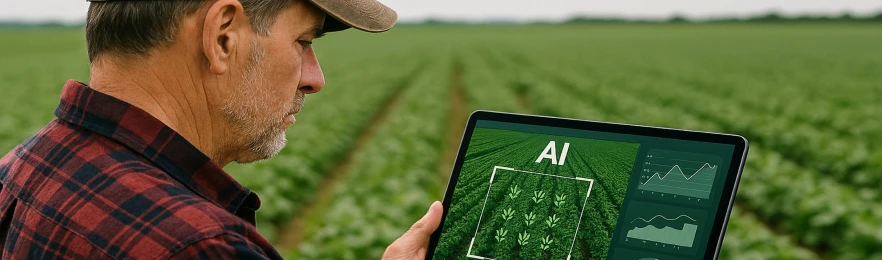
This large-scale analysis allows the system to identify patterns, predict crop yields with increasing accuracy, build complex models for disease outbreaks, and develop long-term strategies for optimizing fertilizer use or crop rotation. Farmers can then access this intelligence through a ‘single pane of glass’ dashboard on a tablet or smartphone, giving them a comprehensive overview of their entire operation from anywhere in the world.
Reliability & Autonomy
The combination of cloud and edge is particularly effective in the agricultural sector because it directly addresses one of the most historically significant obstacles to the widespread adoption tech in farming: the lack of reliable, high-speed internet in many rural areas.
A smart farm that relied exclusively on the cloud would be vulnerable, as the entire system could grind to a halt with a single cut cable. Edge computing creates operational autonomy and resilience so core automated systems like irrigation, greenhouse climate control or livestock feeding continue to function intelligently and efficiently. This is what’s making smart farming a practical solution for today's agricultural businesses.
Furthermore, combined edge and cloud share a self-improving feedback loop that makes the network smarter over time. Edge devices in the field collect and pre-process vast amounts of data, which is curated then sent to the cloud for aggregation with results from diverse other sources. The cloud's AI platform analyzes this massive dataset to refine its predictive models, to the benefit of every client on the platform.
In some ways this form of collective intelligence, where every participant in the network benefits from the experiences of all the others, is simply the evolution of classical farming models. Agricultural communities have always stored vast amounts of data gained from centuries of trial-and-error, which was shared and refined through oral tradition and inherited farms, steadily enhancing the productivity, efficiency, and sustainability of the ecosystem. Cloud and edge do the same, just much faster and more democratically.

eSIM and agricultural IoT
Edge, cloud, and the entire sensor network making real-time decisions and providing deep insights have all only been made possible by the one foundational technology of embedded SIM (eSIM) cards.
The challenges of connectivity in rural areas are well-known and ongoing. It's rarely about a complete lack of service, and more often about inconsistent or patchy broadband and cellular coverage with wild variations in quality from one carrier to another.
A traditional SIM card locked a device into a single network operator. If that operator's signal was weak in a particular location, the device wouldn’t connect.
Service aside, physical SIM cards were ill-suited for the rigors of farm life. They can be dislodged by the vibration of machinery, corroded by moisture, or fail in extreme temperatures.
Repair and replacement, for either network or hardware reasons, was impractical and prohibitively expensive when dealing with sensors potentially scattered across thousands of kilometers and possibly currently inside a cow. In the necessarily remote and rugged environment of agriculture, connectivity that relied on traditional plastic SIM had proved to be an unsupportable expense and liability.
eSIMs are absolutely fundamental to enabling the current age of IoT, for agriculture or any other sector. Their embedded design makes it inherently more durable and highly resistant to shock, vibration, dust, and moisture, which is perfect for a sensor that will spend years in the soil or a control unit mounted on a tractor.
The real difference is made by eSIMs’ capability for Remote SIM Provisioning (RSP). This allows cellular connectivity profiles to be added and switched over-the-air without any physical access. If a device is deployed (or wanders off in search of better grass) to an area where one carrier has a better signal, the profile can be switched over remotely and automatically. If a more affordable or better performing data plan becomes available from a different provider, whole fleets of devices can be switched over with a few clicks on a central management platform.
This remote management capability has had a huge impact on multiple levels of the agricultural supply chain, including equipment manufacturers. In the past, a company making autonomous devices would have to produce different hardware versions for different regional markets, increasing cost and complexity and adding one more potential point of failure. With eSIMs, a ‘single SKU’ manufacturing model is possible, with one universal model with an eSIM. When that hardware, be it a sensor or a self-driving tractor, is delivered to a farm it automatically downloads and activates an appropriate profile for a local carrier upon its first startup.
As it has for the automotive industry, this shift has done more than just simplify logistics. It’s reframed the business model and the client relationship for manufacturers. They no longer just sell hardware in a one-time transaction, but provide a connected-by-default machine with recurring revenue streams through value-added digital services.
They can offer bundled connectivity-as-a-service plans, provide remote diagnostics, push software updates, and sell predictive maintenance subscriptions that alert a farmer when a part is likely to fail before it breaks down.
This is only the start of the new client relationship, as who could be better placed to offer subscription-based farming data analytics than the agri-businesses, some of which have been supplying hardware for over a century?
1GLOBAL and Agricultural Connectivity
The incredible promise of what’s sometime referred to as ‘AgTech’ is only as good as its foundation of reliable, scalable, and easy-to-manage connectivity. Farmers and agricultural engineers need telco partners who understand the unique challenges of deploying and managing thousands of devices in globally remote and often harsh environments.
This is precisely the role that 1GLOBAL fills, providing the specialized IoT solutions and foundational technology required to bring the smart farm to life.
At the heart of the 1GLOBAL offering is the principle that IoT requires specialized connectivity and not just an industrially stripped-down version of a consumer package. This is why eSIM architecture is core to the solutions we offer, not an optional extra to make upgrading to new device more convenient.
1GLOBAL recognizes that flexibility and durability are essential for commercial viability. Our eSIMs are shipped with a bootstrap profile of pre-loaded connectivity that allows devices to connect to a network right out of the box, anywhere in the world. This initial connection is then used to remotely provision the optimal and desired network profile over-the-air, a near-instant and automated process that is essential for large-scale deployments where manual activation is impossible.
Growing with 1GLOBAL
What sets 1GLOBAL apart and makes it a core part of successful commercial farming is our unique global network architecture. Instead of being just another mobile operator, we have built a single, unified core network that aggregates access to over 600 local cellular networks across more than 190 countries.
For an agricultural business running smart-farming hardware, this simplifies everything. They get one contract, one centralized connectivity management platform, and one consolidated bill, while their devices gain access to a ‘network of networks’ that ensures they’re always connected to the best available local carrier in any given location. This approach supports a full range of network protocols, from legacy 2G for simple sensors to high-speed 5G and, critically for agriculture, low-power LPWAN standards like LTE-M and NB-IoT that are essential for battery-powered devices.
All of this is managed through the 1GLOBAL IoT Connectivity Management Platform, an intuitive web-based portal that gives farming businesses complete control over their connected devices, whether that’s individual vehicles and animals, or whole fleets of ground sensors.
This platform is the command center for the entire smart farm's connectivity. From here, administrators can perform remote SIM provisioning to activate or switch network profiles on their eSIMs. They can monitor data usage in real-time and set up powerful automation rules to control costs. The platform is designed for massive scalability, capable of managing everything from a small pilot project with a handful of devices to a full global deployment with millions of connections.

A safer harvest
This streamlining and global network is more than just a convenience, as it fundamentally de-risks IoT hardware capex for agricultural businesses. One of the biggest long-term risks in any IoT project is vendor ‘lock-in’ of being tied to a single cellular carrier whose network coverage might degrade, prices become uncompetitive, not support new technologies or simply stop trading altogether. In earlier applications, it wasn’t uncommon for whole fleets of agricultural IoT devices to become obsolete long before their operation lifecycle was due because replacing their hardware was cost-prohibitive due to inaccessibility.
1GLOBAL's IoT solution eliminates this risk. Their next-gen eSIMs can dynamically and automatically switch between local network partners based on pre-defined rules, such as signal quality or cost. This means a farming business isn't just buying connectivity from one company, but maintaining access to a global, multiply-redundant, and competitive marketplace of networks, all managed through a single, simple interface.
This long-term viability and performance of smart-farming devices future-proofs their investment and allows farmers to focus onfeeding the ever-growing market.
The benefits of IoT for farming are already tangible and transformative. The tech is already leading to significant increases in crop yields. It's driving previously impossible resource efficiency, with documented water savings of up to 30% and reductions in pesticide use by as much as 60%, which not only lowers costs but also drastically reduces the environmental impact of farming. By automating repetitive tasks and providing data-driven insights, smart farming reduces operational costs and empowers farmers to make more proactive productivity decisions.
Connect with 1GLOBAL’s IoT specialists today to learn how our solutions can help your smart farming business bloom.
About 1GLOBAL
1GLOBAL is a distinguished international provider of specialty telecommunications services catering to Global Enterprises, Financial Institutions, IoT, Mobile Operators and Tech & Travel companies. 1GLOBAL is an eSIM pioneer, a fully accredited and GSMA-certified telco, an MVNE, and a full MVNO in ten countries, fully regulated in 42 countries, and covers 190+ countries.
1GLOBAL delivers comprehensive communication solutions that encompass Voice, Data & SMS - all supported by a unique global core network. Its constantly expanding portfolio of advanced products and services includes MVNE services, white label eSIMs, Connectivity Solutions, Compliance and Recording, Consumer & M2M SIM Provisioning and an Entitlement Server.

 is an extensively experienced creative who has worked as a lead copywriter for numerous global clients and international household names, working on through-the-line projects, creative copy, ideation, content, marketing and brand activation for highly diverse industries in the business world. Duncan's career has included almost every sector imaginable, particularly across the tech space, making his news and industry analysis focused on eSIM, IoT and business connectivity both well-informed and engaging.
 )
)
)

