How IoT POS Connectivity Creates Record Retail Revenue
 IoT

On this page
Share:
- Copy this linkLink copied to clipboard
Share:
- Copy this linkLink copied to clipboard
A new report from mobile industry analysts Juniper Research estimates that the annual value of in-store transactions will grow to $41 billion by 2031 – this includes all those made at physical point-of-sale (POS) systems, including card, cash, mobile and other NFC payments. Retailers now need to assess their current POS strategy to prepare for this rising demand.
Summarize this article with AI
The POS market is set for record growth: here’s why connectivity is key
While the demise of brick-and-mortar shopping has been repeatedly foretold (and consistently disproven) since Tiffany’s released its Blue Book mail order catalogue in the 1880s, the Juniper Research report provides a more nuanced prediction: while customers still understand the value of shopping in person, retailers are evolving their physical spaces and transaction experiences to adapt to new expectations, bringing digital services in-store.
Much of this shift is down to new forms of mobile POS systems (mPOS), which bring the ease and speed of in-person payments closer in alignment with the online shopping experience, while freeing up store staff and retailers to explore new, personalized checkout interactions and better leverage every inch of their physical spaces.
With two of the year's busiest sales periods just around the corner (Black Friday, leading into Christmas), we explore how technology like IoT POS systems and eSIMs are changing the industry, as well as the challenges that must be resolved if the sector is to fulfil the Juniper Research prophecy.
The changing face of POS
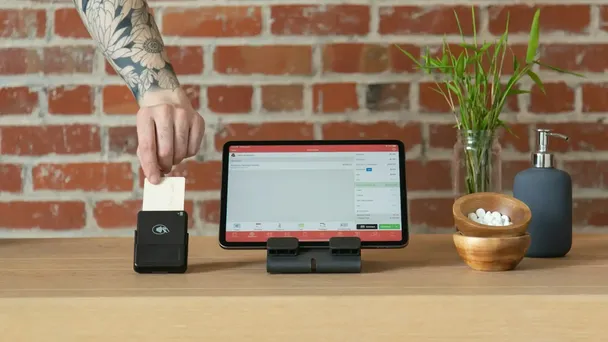
While physical retail is still alive and well, the ongoing rise of online shopping means that in-person payment processes have been forced to adapt, and fast. Fixed-terminal POS systems and traditional checkout lines have in many stores been replaced with wireless setups, self-checkout zones, and more guided employee-customer interactions.
Last year, point-of-sale operator Square released its smallest-ever device, the Handheld, joining microsystems like the Pulse Flex or Toast Go as part of the new wave of mPOS devices. By now, shoppers are well accustomed to settling a bill on a smartphone, and a a larger scale the iPad is a frequent sight in restaurants and stores around the globe.
The Juniper Research forecast is based across a range of POS formats, including:
Dedicated POS
mPOS
SoftPOS
Smart POS
Contactless POS
Biometric POS
Every one of these formats, other than Dedicated POS, relies on wireless connectivity to function. The connectivity speed, reliability, and international coverage ultimately determine the success of the checkout experience.
Going beyond payment: eSIMs, queue management, and unified commerce
Queue management is a field of study in its own right, and one that has a significant impact on revenue, customer loyalty, and branding.
A recent study of German shoppers found that 16% will entirely abandon their purchase in the event of excessive queuing times. This rises to 44% among Gen Z. In an industry as volatile as retail, this can have profound consequences. While this new in-store approach may have been initially motivated by customer frustrations, it was made possible by one technology: the eSIM.
Unlike SIM cards, eSIMs can be remotely distributed to devices all over the world, allowing IT admins to instantly and remotely connect any device to their store system. In the soft POS era, where readily available consumer devices like iPhones and iPads can run POS software and take in-store transactions, the result is next-level flexibility for retailers and store staff. New devices can be activated via eSIM during busy periods (and deactivated as needed). When coupled with a flexible connectivity plan, this means that stores only pay for the connectivity they need.
The same IoT connectivity also allows eSIM POS terminals to gather and process vast volumes of business data in real-time, creating new insights and informing strategic business decisions at the highest level.
In effect, this transforms them from simple payment processors to all-in-one digital hubs for store staff and IT managers. This is unified commerce, and it’s at the heart of the retail industry's future.
Brick-and-mortar stores are seamlessly linked to online channels and will become hubs for a wide variety of services, especially fulfilment.
From PwC's Future of Retail report
What happens when POS connectivity fails?
Transitioning to a wireless, cloud-based system is not without its risks. Any network connection must be supported by backup connectivity sources to prevent outages from halting operations.
Establishing an always-on system
Connected POS availability determines whether retailers can turn peak demand into completed sales.
Retail sales are notoriously inconsistent. In the US, the National Retail Federation estimates that Black Friday shopping accounts for nearly a fifth of total annual retail revenue. The same forecast also predicts that in-person holiday shopping will only grow in the future, with total sales over winter 2026 expected to top $1 trillion for the first time.
With Black Friday and Cyber Monday fast approaching, retailers are preparing their staff and facilities for the predicted spikes in customer numbers and transactions. A key element of this preparation is testing, assessing, and upgrading the resilience of their connected POS systems.
Sometimes, outages can be beyond human control. It's up to retail leaders to ensure their stores and systems are insured against this via a multi-network, multi-IMSI connectivity strategy.
Multi-network connectivity means that each device is supported by more than one mobile network – if the signal drops, the devices can reconnect to a backup network and continue operations. The more available networks there are, the more protected companies are from outages.
Multi-IMSI connectivity is closely related: it ensures the devices’ eSIMs continually search for and connect to the best available local network. Not only does this improve connection speed and performance during regular trading, but it also provides an additional layer of protection against signal outages: devices will instantly and automatically switch networks when affected, minimizing downtime and safeguarding revenue.
One key consideration of establishing a multi-network POS connectivity fleet is roaming access. Companies will usually need to negotiate and maintain individual roaming agreements with each network provider. When operating multiple stores across different coverage zones and markets, the legal and administrative workload this requires can offset the advantages.
Alternatively, retailers can work with a specialist IoT POS partner like 1GLOBAL and connect all their devices across the globe with a single connectivity agreement.
Entering new markets with eSIM-based IoT POS
Expanding internationally is not just a question of reaching more customers: operating in multiple regions can hedge against the seasonality of retail sales, with off-seasons in some markets offset by sales periods in others. China’s Singles Day (November 11) began in 2009 and now generates over $150 billion a year.
Aside from the in-store benefits to staff and customers, a connected POS system has significant upstream benefits: by linking all terminals through a wireless service (ideally through a single connectivity partner), retailers are able to oversee, manage, and update all store systems, worldwide, from a single point of contact.
The 1GLOBAL IoT POS service provides IT teams with a single-pane-of-glass approach to retail: teams can instantly update and manage every device across all their stores from a single digital hub. New devices can be instantly activated or recalled in seconds, allowing teams to adjust the size of their fleets in response to seasonal demand. The 1GLOBAL eIM is based on SPG.32 principles, designed to facilitate simple remote management of POS devices, even as fleets and connectivity needs evolve over time.
The same single platform collates usage data, analytics and insights from all stores worldwide, providing managers with a new level of user research.
1GLOBAL POS IoT connectivity for retail
Retailers can’t predict what customers will expect five or 10 years down the line. They can, however, replace single-purpose, dedicated POS terminals with software-based systems that can be continually updated and repurposed as needs evolve. Instilling this flexibility is key to long-term success in a notoriously competitive market.
1GLOBAL provides retailers with a three-part solution for their POS strategy:
Multi-network, multi-IMSI connectivity to guard against downtime and protect revenue.
A single roaming agreement for 190+ countries, allowing for flexible, ongoing deployment and recall of POS devices around the world.
A centralized control and diagnostics platform to remotely manage POS devices and gather insights from all stores.
Increased efficiency creates a competitive edge, which in turn drives long-term growth potential. While the Juniper Research report bodes well for the retail industry as a whole, individual companies must ensure their systems are primed to take advantage. This starts with a flexible, future-ready connectivity strategy, backed by an always-on network and an international partner.
1GLOBAL supplies eSIM retail solutions to international retail brands – find out more about how our connectivity services can help your business, or speak to our team today.

 is a seasoned telco leader driving commercial strategy and technical innovation at 1GLOBAL. With deep-seated expertise spanning eSIM tech, global IoT connectivity, and complex enterprise mobile deployments, he's an expert at translating complex technical frameworks into high-impact growth strategies and digestible, insightful articles. Throughout his career, Maksim has guided multinational brands and financial institutions through large-scale digital transformations, enabling them to successfully launch their own embedded connectivity solutions. As a core contributor to the 1GLOBAL blog, his posts provide actionable insight into navigating regulatory compliance, optimizing international roaming architectures, and fortifying mobile network security.