Why the iOS 26 eSIM Auto-Switching Feature is So Important
 Tech & Travel
)
On this page
Share:
- Copy this linkLink copied to clipboard
Share:
- Copy this linkLink copied to clipboard
In June 2025, Apple officially announced a successor to the current iPhone operating system, iOS 18. The new system, known as iOS 26, is due for a worldwide release on September 9.
Summarize this article with AI
Selected reviewers, developers, and Apple customers have been able to test and review the Beta version for months. Thanks to this partial release, most of the details and characteristics of the new operating system are already known to the public.
As the first major iPhone software overhaul in over a year, iOS 26 introduces a wealth of new improvements and updates, from the superficial to the indispensable.
With iOS 26, Apple has emphasised its commitment to eSIM connectivity with a slew of eSIM-based services and options. As a major international influence in consumer telecommunications, this advance from Apple affirms the eSIM’s key role in the future of telecommunications and consumer mobile tech.
What's new in iOS 26?
The most immediately apparent changes in iOS 26 are cosmetic: Apple has eschewed the minimalist design language of recent systems and reverted to the 3D maximalism of late-2000s iOS versions, including glossy notifications and banners, detailed app icons, and a new series of semi-translucent animations and UI elements collectively known as “Liquid Glass".
Also notable is the migration of the Smart Clock feature from recent iPadOS versions to iOS, which automatically adjusts the lock-screen clock to fit around individual elements of the phone’s background image.
Under the surface, iOS 26 introduces a range of functional updates that subtly transform the capabilities of the iPhone.
eSIM auto-switching
One of the most revealing features is the new auto-switching function for eSIMs. With the addition of a small toggle in the Settings app, Apple has made life easier for the millions of iPhone users who currently use an eSIM.
One of the most popular consumer eSIM uses is downloading a temporary travel eSIM to get online without paying roaming fees. It’s this market that Apple serves with the new auto-switching function.
How eSIM auto-switching works
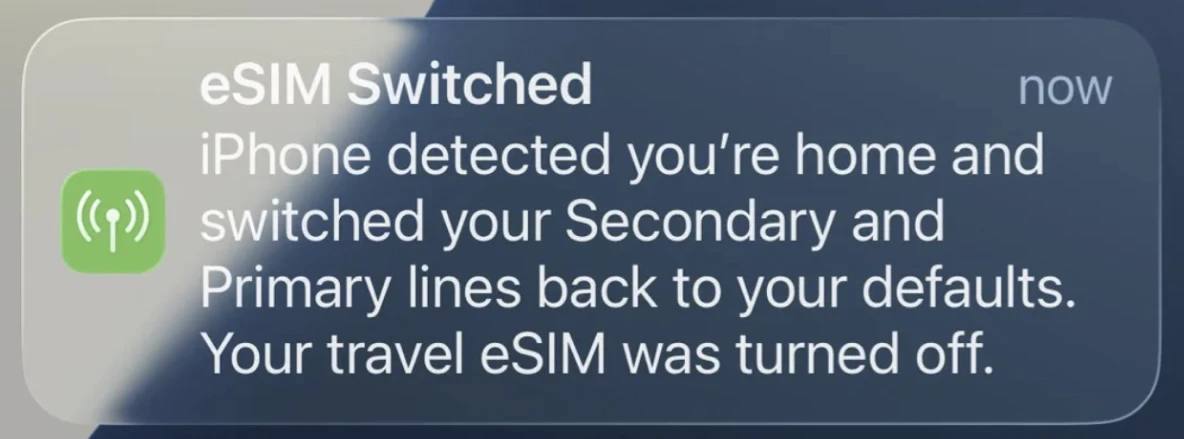
The concept behind auto-switching is straightforward: when a user downloads an eSIM for the first time, they have the option to designate it as their primary “home” eSIM or as a temporary travel eSIM.
When the iPhone location services detect that the owner has left their home country, it will automatically deactivate the primary eSIM and activate the travel eSIM. The reverse is true when they return home. Alternatively, both SIMs can be left active while traveling, depending on user preference.
Here's how it works in practice:
The user downloads a new eSIM. On iOS 26, they are then given the option to label the eSIM as “Home” (in the case of long-term SIM profiles for domestic usage) or “Abroad” (for temporary travel eSIMs, used to avoid roaming fees when traveling to other countries).
Next, the user selects whether their eSIM is a data-only eSIM plan or a full data, voice, and SMS plan.
If the selected travel eSIM is data-only, the user has the option to deactivate their regular SIM automatically and only use the data-only eSIM while traveling. They will be unable to make calls or texts with their regular eSIM, but will also avoid roaming charges.
Alternatively, they can choose to keep both their domestic and travel eSIMs active while traveling – their device will then automatically use the travel eSIM to access mobile data abroad, and the regular eSIM for SMS messages and calls (which may incur roaming charges).
The iPhone will automatically detect when the owner is traveling outside their home country and apply their chosen travel eSIM preferences accordingly.
Why the iOS 26 eSIM auto-switching matters
This update is a significant functional improvement — it's also symbolic of evidence of Apple’s ongoing innovation in the eSIM space, and wider public demand for eSIM-based mobile services.
With the successor to iOS 26 not expected for at least another 12 months, the new eSIM-centered system illustrates how essential Apple considers the technology for the near future.
Apple and eSIMs
Much of the ongoing global mass adoption of eSIMs has been driven by device manufacturers like Apple: replacing a bulky SIM tray and plastic card with a minuscule chip frees up internal space for other components like larger batteries, faster processors, and bigger cameras. No SIM tray also means fewer opportunities for dust and moisture to enter, improving device reliability and performance.
Even by manufacturer standards, Apple was an early champion of eSIM connectivity. The 2022 eSIM-only iPhone 14 model marked a watershed in public awareness of eSIM.
The transition from physical SIM to eSIM has also benefited Apple’s wider hardware ecosystem. The comparatively small footprint of eSIMs has enabled the ongoing popularity of the Apple Watch smartwatch line, all of which are available as cellular models with built-in eSIM connectivity — the first eSIM-capable Apple device was the 2017 Apple Watch Series 3. The following year, the manufacturer extended eSIM capabilities to its iPhone and iPad lines.
The next major step was the introduction of dual active eSIM functionality, first seen in the iPhone 13. Where previous iPhone models were able to store up to eight separate eSIM profiles, only one could be active at a time (usually in tandem with a SIM card profile). With the iPhone 13 (and all subsequent models), users can now maintain an active connection to two separate eSIMs at once, for example using a data-only travel eSIM to go online abroad while retaining the ability to make phone calls on their domestic eSIM.
This responded to an ongoing market shift where eSIMs were transitioning from purely temporary solutions to primary SIM profiles. As popular options for both use cases, the market required a phone with the ability to support concurrent active eSIMs.
The eSIM revolution
While manufacturers are keen to promote eSIM usage, the increasing number of eSIM–oriented aspects of the new iOS are also a response to public demand. By 2030, eSIMs are predicted to account for the majority of all smartphone connections worldwide.
Manufacturers are racing to cater to this demand. Formerly reserved for flagship high-end models, eSIM connectivity is increasingly becoming a standard expectation in mid-range and budget smartphones.
The eSIM revolution has also revamped commercial mobile connectivity. Internet of Things (IoT) companies that oversee vast fleets of wireless connected devices can use eSIMs to remotely install, monitor, and recall connectivity for all devices at once.
Businesses with traveling employees or multinational teams can use eSIMs to remotely distribute mobile connectivity plans and connect their staff around the world, with no need to handle physical SIM cards for every new employee, or negotiate new roaming agreements in every country in which they operate.
1GLOBAL eSIM solutions
While the release of iOS underscores the importance of eSIMs in the contemporary telecommunications world, the format is still an emerging technology. Scalable eSIM solutions will be an essential tool for serving the rising global demand.
1GLOBAL is an industry-leading eSIM service provider, having deployed more than 60 million eSIM profiles together with clients across dozens of industries, including IoT, consumer electronics, fintech, and telecommunications.
Learn more about our eSIM services, or contact our team directly to discuss how 1GLOBAL can support your business’s ambitions.
About 1GLOBAL
1GLOBAL is a distinguished international provider of specialty telecommunications services catering to Global Enterprises, Financial Institutions, IoT, Mobile Operators and Tech & Travel companies. 1GLOBAL is an eSIM pioneer, a fully accredited and GSMA-certified telco, an MVNE, and a full MVNO in ten countries, fully regulated in 42 countries, and covers 190+ countries.
1GLOBAL delivers comprehensive communication solutions that encompass Voice, Data & SMS - all supported by a unique global core network. Its constantly expanding portfolio of advanced products and services includes MVNE services, white label eSIMs, Connectivity Solutions, Compliance and Recording, Consumer & M2M SIM Provisioning and an Entitlement Server.

 is a content specialist and creative copywriter covering tech, IoT, and eSIM topics for 1GLOBAL. Since completing a BSc in Environmental Conservation, he has worked in the arts, science, and NGO sectors. He lives and works in Berlin.
)
)
)

